How Much Revenue Do Roofers Lose Missing Calls?
How much revenue do roofers lose missing calls? Compare the math, the sources behind the numbers, and what a fix costs versus the leak.
By Bogdan Stere
· 5 min read
Vertically, which publishes this blog, is the author's product and is mentioned briefly in the comparison below.
If you want a rough answer to how much revenue do roofers lose missing calls, the honest starting point is a formula you can check against your own books, not a headline figure. Published estimates range from tens of thousands to several hundred thousand dollars a year, and they differ mainly because each vendor assumes a different miss rate, job value and close rate. This post shows how to run the math on your own numbers, what the published estimates assume, and how the main fixes compare.
Why the Missed Call Number Is Hard to Pin Down
Vendor sources report very different loss figures. OnCallClerk models roughly 40 calls a week with half answered and a 12% close rate on a $9,500 replacement, which lands near $180,000 a year in typical conditions (OnCallClerk). ServiceBusiness cites a $50,000 to $150,000 annual range built on a 22% missed rate and $8,500 to $15,000 lead values ([ServiceBusiness](https://www.servicebusiness.NextPhone's calculator puts an average contractor's loss at $260,400 a year using a 74% miss rate and $3,500 jobs (NextPhone).
Each of those figures can be internally consistent and still be far from your business. Treat any single headline number as a vendor estimate, not a benchmark.
Run the Math on Your Own Numbers
The structure most of these sources share is simple: missed calls multiplied by the share that would have booked, multiplied by average job value. NextPhone describes it as missed calls times close rate times job value (NextPhone).
The basic formula
- Missed real leads per month = inbound calls per month × share unanswered × share that are genuine job prospects
- Jobs lost per month = missed real leads × share that would have booked
- Revenue lost per year = jobs lost per month × average job value × 12
A worked example with your inputs
Here is a hypothetical example, not a real business. Suppose you get 60 calls a month, answer half, and 1 in 10 of the unanswered calls is a real replacement prospect. That is 3 missed real leads a month. If 1 in 4 of those would have booked, you lose 0.
Swap in your own figures. Pull the missed call count from your phone system, use your closed-job average from your accounting software, and estimate the close rate from jobs won divided by leads you actually spoke to. Real inputs will give you a number you can defend, which is more useful than any industry default.
What the Published Estimates Assume
The main differences come from three assumptions.
Miss rates. Sources use widely different figures. ServiceBusiness cites 22% of inbound calls missed during business hours, and NextPhone cites 74% across the average contractor (ServiceBusiness). Your number depends on whether you work alone on roofs or have an office person, and on the hours you cover.
Average job values. Ethoslinksystems uses $9,526 as the 2026 residential baseline (Ethoslinksystems). Use your own average, not a headline figure.
Storm-surge estimates depend on call volume assumptions that rarely hold in ordinary weeks. com/offers/roofing-ai.html)). Those inputs describe a particular kind of demand surge, so do not read them as a typical year.
Comparing Ways to Stop the Leak
There are three common approaches. Each recovers a different part of the loss.
Voicemail and callbacks
Voicemail is the default for most small roofers. The caller leaves a message, and you call back when you can. The cost is time. Most urgent callers will not wait for a return call, and some will have already booked someone else by the time you dial. Callbacks help with non-urgent leads but do little for storm-week or active-leak calls.
Live answering services
A live answering service picks up your business line and takes messages or books appointments. This recovers calls you would otherwise miss, but it works through the phone, and what it does with each call depends on the service's script and your rules. Compare what you pay per month against the number of real leads it actually captures, not just the number of calls it answers. For a deeper look at options, see roofing answering service vs instant lead response.
Instant web lead response
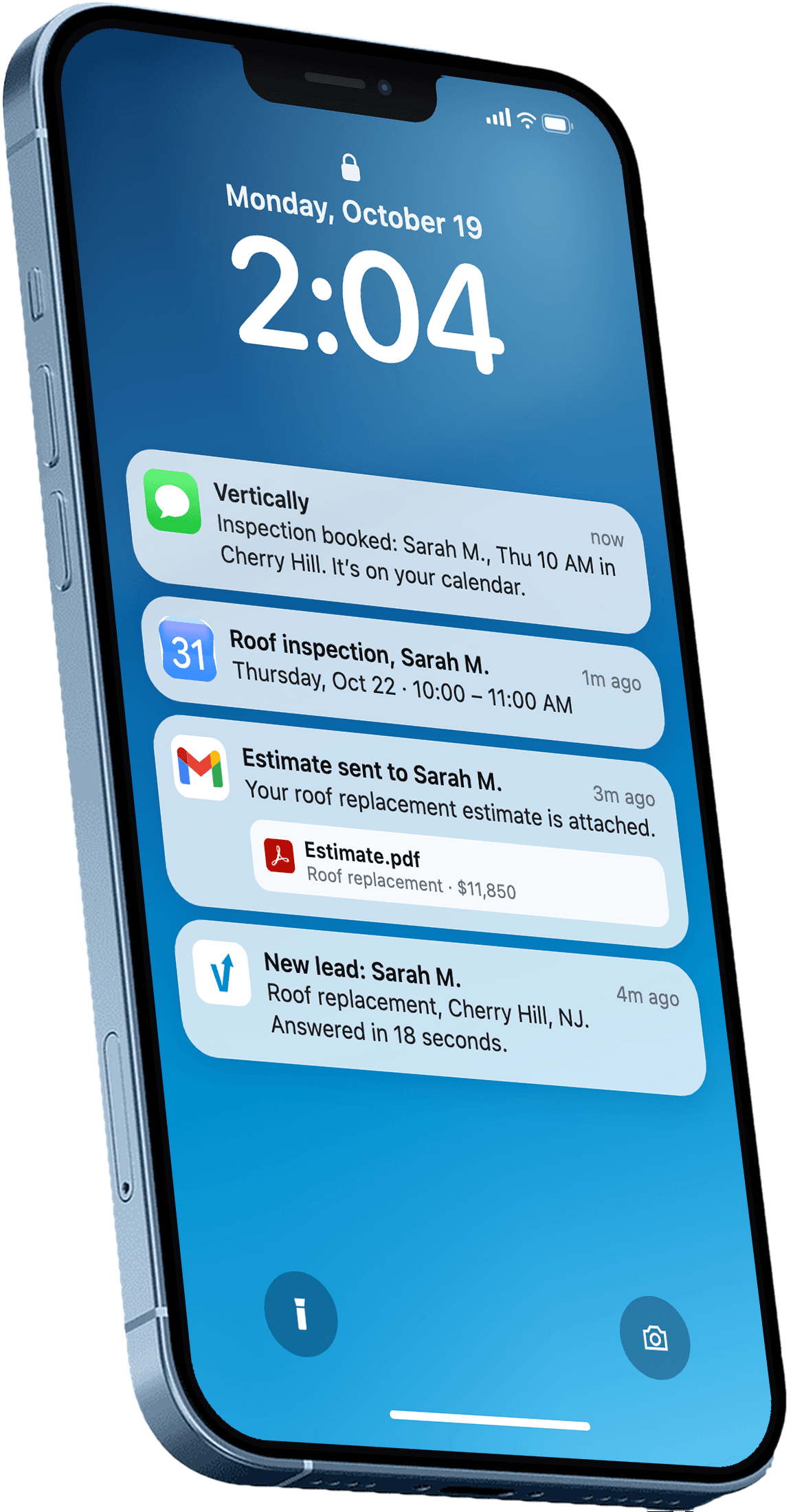
Many roofing leads start on a website form, not a phone call. Responding to those quickly is a separate job from answering the phone. Vertically is the author's product. Its quote page gives the homeowner an instant quote, then sends an AI call about 5 minutes later on your behalf, books the inspection on your calendar and follows up over 28 days. Vertically does not answer inbound phone calls or your business line, so it does not replace a live answering service. It targets the web leads that otherwise go cold while you are on a roof.
| Approach | What it recovers | Main limitation |
|---|---|---|
| Voicemail and callbacks | Non-urgent leads you can return | Urgent callers often book someone else first |
| Live answering service | Inbound calls to your business line | Cost scales with call volume; quality depends on the script |
| Instant web lead response | Web form leads that would wait for you | Does not cover inbound phone calls |
Pick the approach that matches where your leads actually come from. If most of your leads are phone calls, a live answering service is the relevant comparison. If a large share come through your website, instant response to those requests is the gap to close.
What to Do This Week
Start a simple call log. For five business days, record every call you miss: the time, the source if you know it (ads, referral, Google listing, repeat customer), and whether the caller left a voicemail.
At the end of the week, count the missed calls that were real job prospects, not sales calls or spam. Multiply that by your closed-job conversion rate and your average job value. Compare that weekly number to the cost of any fix you are considering. Within a week you will have a rough, honest estimate of how much revenue do roofers lose missing calls at your company, and enough data to choose a fix.
For related reading on the leads that come in outside call hours, see roofing leads during a slowdown.
If you want to see how a quote page would handle the web leads you are already getting, you can start a free 30-day trial of Vertically's quote page, with no contract and no credit card. It sends each requester an instant quote, follows up with a text and an AI call about 5 minutes later, and keeps the follow-up going for 28 days.
Book a short walkthrough at https://cal.com/vertically/free-systems-audit?overlayCalendar=true to see how the quote page would handle your web leads and whether it fits your current setup.
Frequently asked questions
How do I calculate how much a missed call costs my roofing company?
Start with the number of inbound calls you miss in a month, then estimate how many of those were real job prospects. Multiply that by the share you would have closed and by your average job value. Use your own call log and closed-job figures rather than industry defaults, because those vary widely between sources.
What is a realistic missed call rate for a small roofer?
Published figures vary a lot, from about 22% of business-hour calls in one source to 74% across an average contractor in another. Your rate depends on whether you work alone on roofs and what hours you cover. A week-long call log will give you a better number than any published average.
Do missed calls matter more during storm season?
Yes, because call volume spikes in a short window and many callers have urgent damage. Some vendors estimate large losses during storm weeks, but those figures rely on assumed call volumes that do not hold in ordinary weeks. Track storm-period calls separately in your log so you can see the difference.
Is an answering service worth it for a small roofing business?
It depends on how many real leads you miss and what the service costs per month. Compare the service's monthly price against the number of genuine prospects it would capture, not just the calls it answers. Ask how it handles roofing-specific questions and what information it passes to you.
What is the difference between an answering service and instant web lead response?
An answering service picks up your business phone line and takes messages or books appointments. Instant web lead response handles requests that come through your website form, usually by sending a quick estimate and following up. The two cover different lead sources, so the right choice depends on where most of your leads come from.
Answer every lead in under 30 seconds.
Vertically replies to your leads, sends the quote, calls them, and books the inspection on your Google Calendar. Free for 30 days. No contract, no credit card.