How to Get Roofing Leads: 10 Steps That Work
How to get roofing leads: a practical checklist covering referrals, Google reviews, local search, partnerships and fast follow-up for small roofing companies.
By Bogdan Stere
· 4 min read
Most small roofing companies don't have a lead shortage so much as a lead leak. Work comes from referrals one month and dries up the next, and the leads that do arrive often wait too long for a reply. Learning how to get roofing leads consistently means building several sources at once and then following up on each one. The steps below are ones a small company can start this month. For a broader view of the trade-offs, read how to get more roofing leads and stop losing the ones you already have.
Start With the Leads You Already Have
Your past customers are the cheapest source you have. The catch is that referrals only happen if you stay in touch after the job ends. A short check-in, a photo of the finished roof, or a seasonal maintenance reminder keeps your name in front of people who already trust you.
Timing matters for the ask. GAF suggests putting a review or referral request in the [warranty packet homeowners receive after a job](https://www.gaf.That moment is when the homeowner is most pleased with the work.
Put a simple refer-a-friend offer in writing. A gift card or a discount on the next service is common, and you can track which referral converts to a signed contract.
Build Trust Where Homeowners Search
Google Business Profile
Your Google Business Profile is often the first thing a local homeowner sees. Keep the hours, service areas and categories accurate. Post finished-job photos and short updates on a regular schedule, not just when you remember.
Local search is competitive, so treat the profile as ongoing work rather than a one-time setup. For the local tasks that matter most, see setting up the local pieces of roofing SEO.
Reviews
Reviews are one of the strongest drivers of roofing leads. Eagleview reports that companies with 50+ Google reviews and a 4.5+ star rating tend to dominate local visibility and homeowner trust. You won't reach that number by asking occasionally.
Ask every customer at job completion. Send a direct link by text or email the same day, and reply to every review, positive or negative. Replies to bad reviews are read by future customers too, so keep them calm and specific.
Use Neighborhood and Local Partnership Tactics
Neighbor knocking after a job
When a roof goes on, the neighbors can see it. Roofr suggests knocking on about 10 doors around a finished job site, since homeowners see your truck, your crew and your work firsthand. It costs time, not ad budget, and it works best right after the crew finishes, when the work is visible.
Partnerships with complementary local businesses
Trades that serve the same homes can refer customers both ways. RoofSnap points to HVAC companies as an example: an HVAC tech on a new AC install can recommend a roof check, and you can return the favor. Homeowners' associations that keep preferred-vendor lists are another route worth asking about.
Add Paid and Structured Channels When Ready
Paid channels make sense once your basics are working, because they amplify a process that already converts. Google Local Services Ads and Google Search Ads capture homeowners who are actively searching. Minyona says Google Ads capture homeowners at the moment of highest intent. Start with a small budget and track which keywords produce booked jobs, not just clicks.
Free inspections give homeowners a reason to pick up the phone. GetJobber lists offering free roof inspections as one of its twelve lead tips. Be clear about what the inspection includes and how long it takes, so the offer doesn't create extra unpaid work.
Lead marketplaces are another option. They can produce volume, so compare cost per booked job before you commit.
Respond Fast and Follow Up Consistently
A lead that waits is a lead that moves on. Eagleview notes that contractors who streamline quoting and follow-up can handle higher volumes without sacrificing quality.
Most leads also need more than one touch. Minyona recommends a follow-up sequence of calls, texts and emails over time, because many sales take several touchpoints. Write the sequence down so it runs the same way every time, even on busy weeks.
Weekly Checklist to Run
- Ask for two reviews from recent customers.
- Post one finished-job photo to your Google Business Profile.
- Follow up on every open quote from the past week.
- Track which source produced each booked job, so you know where to spend more time.
Recommendation: Start With Follow-Up
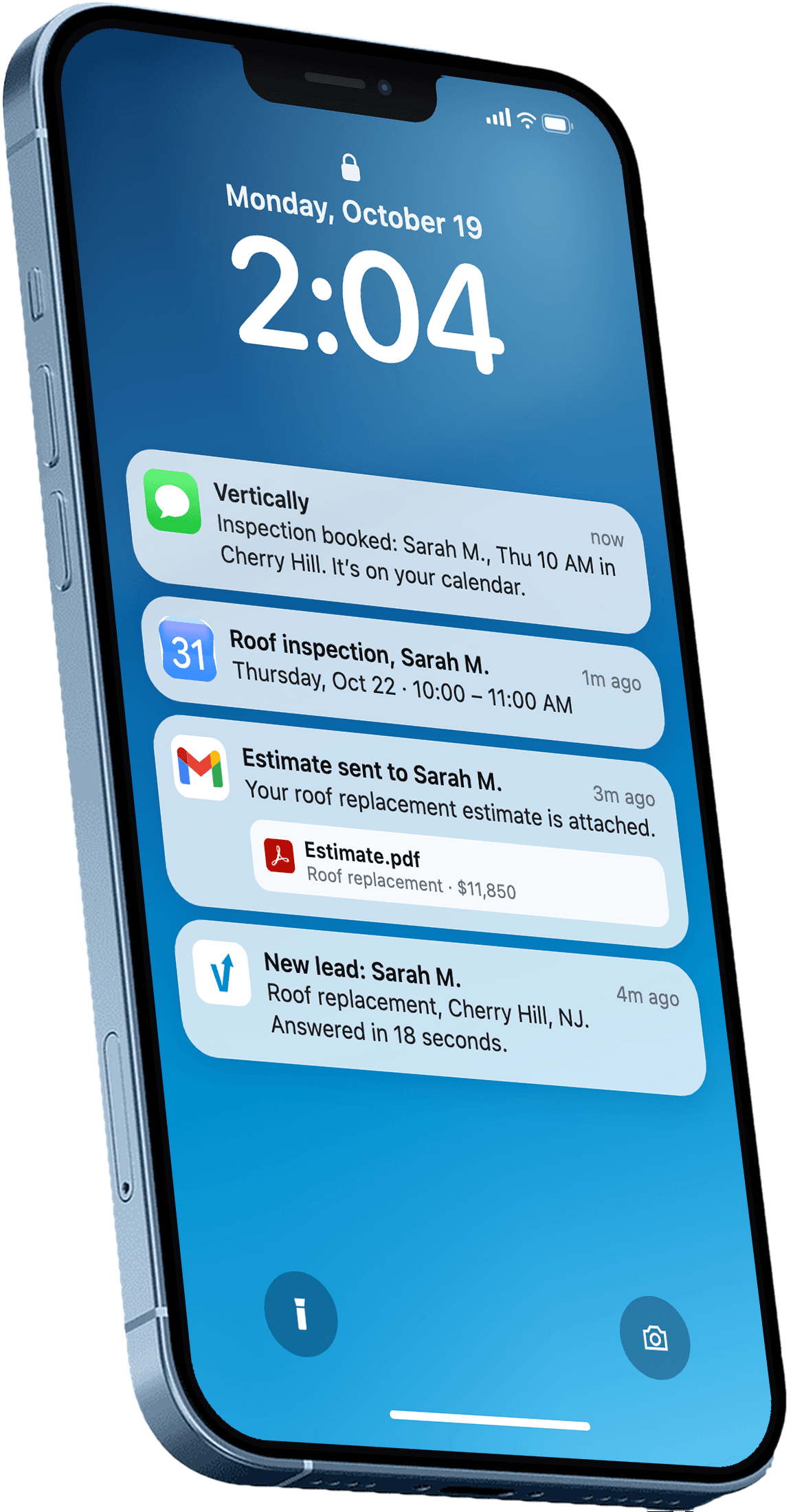
If you do only one thing this week, audit your open leads and check how long each one waited for a first reply. Fixing response time costs nothing and helps every channel you already run. Vertically, which publishes this blog and is the author's product, is one option for this: it sends web leads an instant quote, a text, and an AI call about 5 minutes later, then follows up for 28 days. You can try it free for 30 days, with no contract or credit card and see how it fits your leads.
Frequently asked questions
How many roofing leads should a small company expect per month?
The number depends on your market, your service area and how many channels you run, so no fixed figure applies to every company. The more useful measure is how many of your leads turn into booked inspections and signed jobs. Track each source for a few months to see your own baseline.
Are referrals better than paid leads for roofers?
Referrals usually close more easily because the homeowner already trusts the source, but they are hard to scale on their own. Paid leads can add volume quickly but often cost more per booked job. Most small companies do best with referrals as a steady base and paid channels to fill gaps.
How long does it take to see results from Google reviews?
Reviews build gradually, so the effect shows up over months rather than days. Asking every customer at job completion, and replying to each review, speeds that up. The gain compounds, since more reviews support local visibility and homeowner trust over time.
Should I pay for leads from lead generation sites?
It can make sense if you measure the cost per booked job and can respond quickly to every lead. Response speed and follow-up matter more than the source alone, so track outcomes closely. Test with a small budget before committing to a larger spend.
Answer every lead in under 30 seconds.
Vertically replies to your leads, sends the quote, calls them, and books the inspection on your Google Calendar. Free for 30 days. No contract, no credit card.
Keep reading
- GuideHow to Get More Roofing Leads (and Stop Losing the Ones You Have)How to get more roofing leads: practical sources, then why speed to lead and follow-up decide how many you win, with a real roofing case study.Read more
- GuideRoofing SEO: Set Up the Local Pieces FirstRoofing SEO starts with your Google Business Profile, service pages and reviews. Here is the order to work through them this month, with sources.Read more