Call Forwarding for a Roofing Company: 4 Setups Compared
Learn how to set up call forwarding for a roofing company, compare four common setups, and test routing so storm and repair calls don't go unanswered.
By Toby Karamoutchev
· 6 min read
On this page
Disclosure: Vertically, which publishes this blog, makes one of the products discussed here.
If you're on a roof all day, your business phone is the easiest lead to lose. Learning how to set up call forwarding for a roofing company means deciding who or what picks up when you can't, and then testing that it really happens. Most setups take under an hour. The harder part is choosing the right method for how your calls come in.
Below are four common setups, what each one costs in effort and money, and a test routine to confirm it works before a storm season does it for you.
Why call forwarding matters for a roofing company
A call that rings through while your crew is on a steep slope is a lead that may call the next roofer on the list. Forwarding decides where that call goes when you can't answer.
The routing itself is a configuration task, not a construction project. You can set most of it up from your phone provider's settings or a business phone dashboard in an afternoon.
Compare the main call forwarding methods
There are three broad approaches, and a fourth "combined" option that many roofers end up with.
Carrier forwarding on your existing line
This is the forwarding built into many mobile and landline plans. Novacall AI's guide to small business call forwarding describes basic routing as often free or $5 to $10 a month, but it only routes calls to another number. It doesn't qualify the caller or book anything.
The main limitation is that carrier forwarding is mostly all-or-nothing unless you set conditions such as "forward when unanswered" or "forward after hours." Set the conditions carefully, because a forward to a phone that is also on a ladder just moves the problem.
Call tracking numbers per channel
Call tracking gives each marketing channel its own number and reports which channel the call came from. NeverMiss's guide to stopping missed calls gives an example of a tool at about $45 a month, with one number each for Google Ads, your website and your Google Business Profile.
Tracking helps you see where calls come from and which channels go unanswered. It doesn't answer anything by itself, so you still need forwarding behind each tracking number.
Forwarding to an answering service or AI receptionist
Here the forward goes to a live answering service or an AI system that takes the call, sorts urgent work from routine estimate requests, and books or takes a message. Pricing varies widely. SkipCalls lists an AI answering plan from $19.99 a month, while Novacall AI describes tools from $5 to $500+ a month depending on the features and call volume.
Before you pick one, compare how each handles emergencies, whether it can see your calendar, and what it charges per call versus per month. Our guide on what to look for in a roofing answering service before you sign covers the questions worth asking.
A combined setup
Many roofers layer these together: a main office number, a ring group for the owner and an estimator, and an answering service as the final fallback. NeverMiss describes a cascade of primary office line, then the owner's cell after four rings, then a designated roofer, then an answering service rather than voicemail. You can often build this on a VoIP business phone system, which several providers offer for about $25 to $50 a month for a small team.
Whichever method you pick, keep the final fallback in mind. A voicemail box is the last stop in many setups, and it is one that can lose leads.
Set up forwarding rules that fit a roofing day
A practical roofing call flow usually has three layers.
- Business hours: Ring the office or the estimator first, then the owner only if nobody answers.
- After hours and weekends: Route urgent calls such as an active leak during rain to an on-call person, and send routine estimate requests to intake.
- Storm days: Switch to simultaneous ringing so several people can answer at once.
SkipCalls recommends a simple version: an auto-attendant that asks whether the caller has a leak, storm damage or wants an estimate, then a ring group, then voicemail with a short script. Its point is that you shouldn't need to reach for your phone on a roof to do this.
Forward on no answer and after hours
Forwarding on no answer keeps the business number working during the day while you're busy. Forwarding after hours covers the calls you would never pick up anyway. Set both, rather than forwarding everything to one cell phone, which is a common cause of missed calls.
Escalate urgent calls such as active leaks
Give urgent calls a separate path. An active leak during rain and a tree through a roof should reach a person who can act. Routine estimate requests can wait for intake. If your system can't tell those apart, script the question at the start of the call so the caller sorts themselves into the right queue.
Test the setup before you rely on it
A forwarding rule that looks right on paper can fail in practice because of a carrier setting, a wrong number, or a voicemail that never plays.
Run a test call from each line
Call each business number from a mobile phone and from a landline if you have one. Let it ring through each stage: the office, the owner's cell, the fallback. Confirm that the right person or system answers at each step. Then leave a voicemail and check it arrives.
Confirm the handoff and voicemail
Check that the handoff gives the caller a sensible message, not a dead tone. Check that the voicemail greeting names your company and asks for the address and a callback number. Read the transcript or listen to the recording to make sure the details came through.
Repeat this test after any carrier change, tool change or new team member. Forwarding rules can break quietly after a change to a phone plan.
Measure whether calls are actually answered
Call volume is the wrong number to watch. Track two things instead.
- Answer rate: the share of calls that reach a person or a system that captures the caller's details.
- Response time: how long a caller waits before someone calls or texts them back.
If you use call tracking, check which channel's calls go unanswered most often. A Google Business Profile number that goes to voicemail after hours is worth checking first. Fix the channel with the most dropped calls first.
Where a roofing answering service fits
Forwarding moves a call to a human or an AI. It doesn't answer the phone on its own. The real decision is whether the thing you forward to can triage, book and follow up. For how a dedicated service compares with instant lead response on the web side, see roofing answering service vs instant lead response.
What to do this week
Pick the setup that matches how your calls actually arrive. If most of your work comes from web requests and you're often unreachable, start with carrier forwarding and a fallback. Then run the test calls above from both phone types, and write down the result for each stage. Once the routing works, look at your answer rate after two weeks and decide whether you need an answering service behind it.
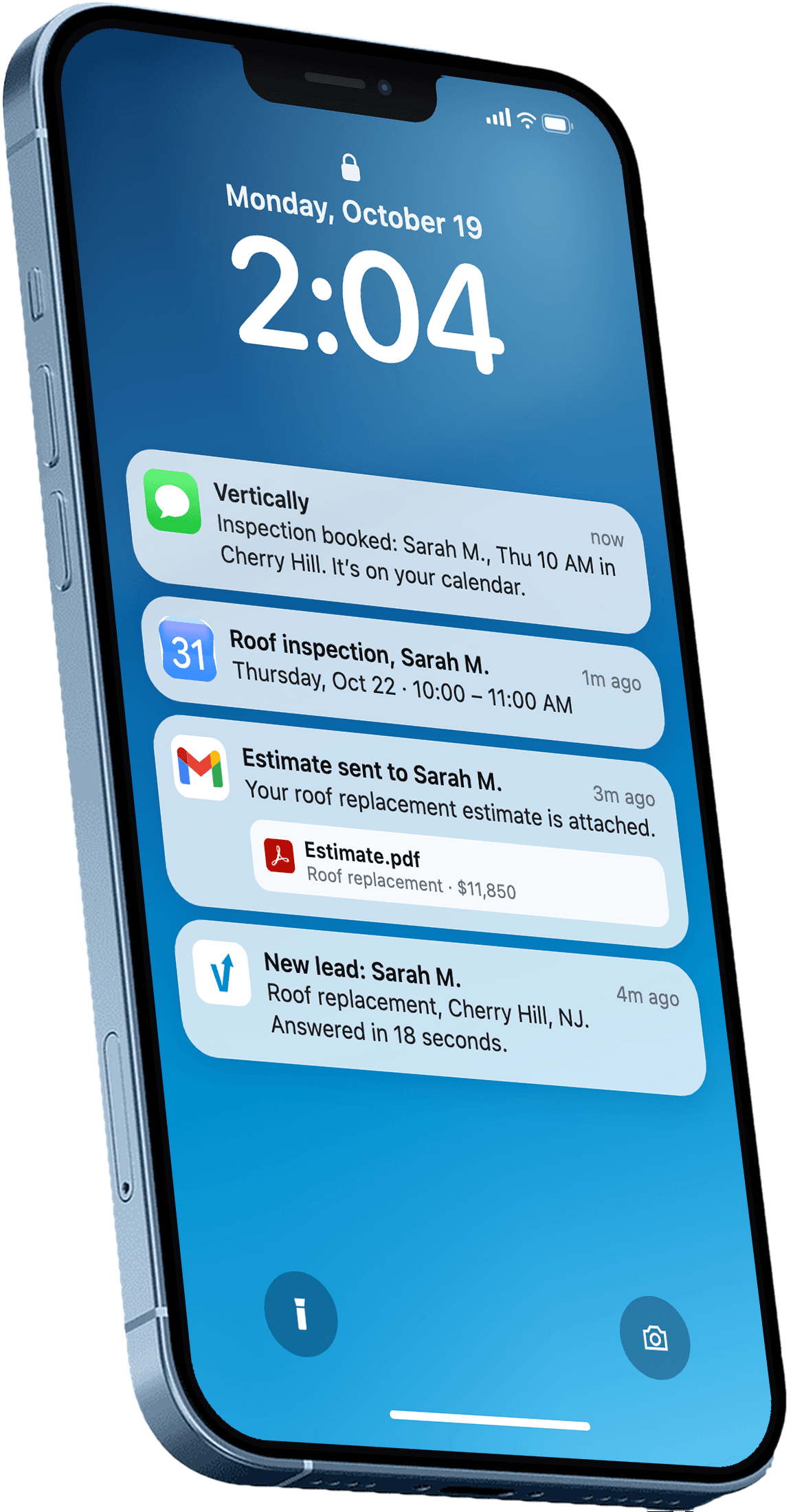
If you want help with the web side, Vertically builds a quote page on your website. A homeowner who requests a quote gets an instant estimate by email with a PDF that carries your branding, and a text saying the quote is in their inbox. About 5 minutes later, an AI call on your behalf can book an inspection onto your Google Calendar. Vertically does not answer inbound calls to your business line, so forwarding still matters for the phone. You can try it free for 30 days with no contract and no credit card, or book a free systems audit at https://cal.com/vertically/free-systems-audit?overlayCalendar=true to see how it would fit your setup.
Frequently asked questions
Will call forwarding work if my crew is on a roof all day?
It can, if the forwarding goes to someone or something that can answer while your crew is working. A forward to a single cell phone often fails because that phone is also on a ladder or in a truck. Using a ring group or an answering service as the fallback is the more reliable approach.
Does forwarding cost extra with my phone carrier?
Basic carrier forwarding is often free or costs a few dollars a month, depending on your plan. Business phone systems and call tracking cost more, and answering services are priced separately. Check your current plan's terms before you assume it's free.
Should I forward every call or only missed ones?
Many roofers forward only when the line is unanswered, busy or after hours, so the office line still works during the day. Forwarding every call can be useful on storm days when you know you won't be reachable. Choose the rule based on when calls actually come in.
How do I know my call forwarding is working?
Make test calls from a mobile phone and a landline, and let each call ring through every stage of the setup. Confirm the right person or system answers at each step and that voicemail records and arrives. Repeat the test after any carrier or tool change.
What is the difference between call forwarding and a call tracking number?
Call forwarding sends a call from one number to another so someone can answer it. A call tracking number is a separate number assigned to a marketing channel so you can see which channel the call came from. Some roofers use both, with tracking numbers forwarding to the main line.
Answer every lead in under 30 seconds.
Vertically replies to your leads, sends the quote, calls them, and books the inspection on your Google Calendar. Free for 30 days. No contract, no credit card.