Roofing Lead Follow-Up Cadence: A Practical Schedule
Build a roofing lead follow-up cadence with timing, channels, message goals, stop rules, and tracking to see which touches book inspections.
By Bogdan Stere
· 6 min read

On this page
Most roofing leads don't go cold because they were bad. They go cold because the first call went unanswered and nobody followed up on a set schedule. A roofing lead follow-up cadence is a planned sequence of touches over the first two weeks, with a clear reason for each one and a point where you stop. This post gives you a day-by-day schedule, the message goal for each touch, stop rules, and a simple way to track which touches actually book inspections.
Why most roofing leads go cold after the first contact
A homeowner who asked for a roof inspection and didn't pick up is usually busy, not uninterested. Many lost roofing jobs happen after that first unanswered contact. The common default is reactive follow-up: the rep calls again when they remember, sends one text, and the lead fades into a spreadsheet nobody revisits. [S3] describes this reactive model as the industry default and argues that it quietly loses deals, because follow-up happens only when someone happens to think of it.
A planned cadence treats the first quote or call as one touch in a sequence, not the finish line. That reframing is most of the work.
The silence after an unanswered call
Silence after one call is normal. People are driving, at work, or screening unknown numbers. Reaching a homeowner often takes several attempts across different times of day and different channels. If your process assumes one attempt is enough, the process is the problem, not the lead.
Set the first response window and an owner
The first touch matters most because the homeowner just asked for help. General lead-response research favors fast first contact, and roofing-specific data on exact timing is thin, so treat "within minutes" as the target rather than a proven threshold [S2]. The practical rule: the request should not sit in an inbox until tomorrow.
Assign one owner per lead. When everyone can see a lead, nobody owns it, and each person assumes someone else will call. [S4] recommends a named owner for every lead, with a status that shows the next action and who is responsible for it.
An automated text on arrival can confirm the request and set expectations, such as when the homeowner will hear from you [S5]. Keep the wording plain and accurate about what happens next.
Respond fast with one clear person in charge
Pick one person for each lead, even if that person is the office manager on a slow day. Write down the owner, the next action, and the time it's due. That single habit does more than any new tool.
A sample follow-up cadence over 10 to 14 days
A workable shape is one immediate response plus roughly 5 to 7 helpful touches over 10 to 14 days [S2]. [S4] proposes a similar five-touch version. Here is one schedule you can adapt:
| Timing | Channel | Goal |
|---|---|---|
| Immediately | Call, plus text or email | Confirm the request and ask for an inspection time |
| 1 to 3 hours later | Text or email | Make the next step easy to answer |
| Next business morning | Call or text | Reach them when they're likely free |
| Day 3 to 4 | Email with a relevant photo or note | Give a reason to reply, not just "checking in" |
| Day 7 | Text | Ask if they still want help |
| Day 10 to 14 | Email or text | Close the loop politely and offer a clear yes or no |
If the lead is urgent, such as an active leak, compress the early touches. A normal replacement inquiry can use the calmer pacing above.
Day 0 to Day 2: first touches
Make the first two or three touches fast and simple. Confirm the request, name the next step, and ask for one thing: a time for the inspection. Don't send a long message with the full company history.
Day 3 to Day 14: helpful, spaced follow-ups
Space the later touches out and give each one a real reason. A useful note, a photo of a similar repair, a scheduling window, or a weather-related reason to look at the roof is better than repeating "just following up" [S3]. The later touches are where most homeowners who are still interested will reply.
Message goals for each touch
Each message should do one job. Early touches confirm the request and offer a time for an inspection [S4]. Middle touches supply a reason to act. The last touch gives the homeowner an easy yes or no.
What each message should accomplish
- Touch 1: confirm you received the request and propose a time.
- Touches 2 to 4: add something useful, such as a short explanation of what the inspection covers or a photo of a similar job.
- Touches 5 to 6: give a practical reason to decide now, such as your next open window. Don't invent urgency.
- Final touch: ask directly whether they want help, and close the loop either way.
How to write follow-ups that don't sound pushy
Keep messages short and tied to the homeowner's specific request. Use their name and the job they asked about. Avoid fake deadlines and vague check-ins. A message that says "Your leak inspection is still open, do you want Tuesday or Thursday morning?" is clearer than "Just circling back!"
Stop rules and when to stop chasing
Stop automated follow-up as soon as the homeowner replies, then have a person take over the conversation [S4]. Sending another automated text after someone has replied is the fastest way to look careless.
Define a clear end point so the sequence doesn't run indefinitely [S2]. For most roofing leads, a sequence that runs about two weeks and then moves to a lower-frequency list is reasonable. Mark the lead cold or move it to a longer nurture list rather than leaving it in active follow-up.
Respect unsubscribes and opt-outs immediately. If someone says stop, stop, and record it.
Stop automation on reply
Set up your process so a reply pauses the sequence and assigns the conversation to a person. Whoever is handling the inbox should answer the homeowner directly.
When to unsubscribe a lead from the sequence
Remove a lead from the cadence when they book an inspection, ask you to stop, decline the job, or hit the end of the sequence without replying. Each of those has a different next step, so record which one happened.
Track which touches book inspections
You can't tune a cadence without knowing which touches produce results. Log each lead's status and touch history so you can see where replies and bookings come from. A basic spreadsheet with these columns is enough:
- Lead name and request date
- Owner
- Each touch: date, channel, and whether it got a reply
- Status: new, replied, inspection booked, cold, or unsubscribed
- Time from request to first response
Review the numbers weekly. Look at first response time, how many leads got at least one follow-up, how many replied, and how many booked [S4]. Watch for leads with no owner, since that number shows where the process is leaking.
Then adjust timing based on what you see. If most bookings come from touch three, make touch three stronger. If nothing works after touch five, shorten the sequence. Let the numbers change the schedule rather than guessing.
Recommendation for this week
Pull your open roofing leads and check three things: does each one have an owner, how long did the first response take, and how many touches has each lead received? Then write your cadence down, even as a one-page table, and assign one person to run it. Start there before buying more leads.
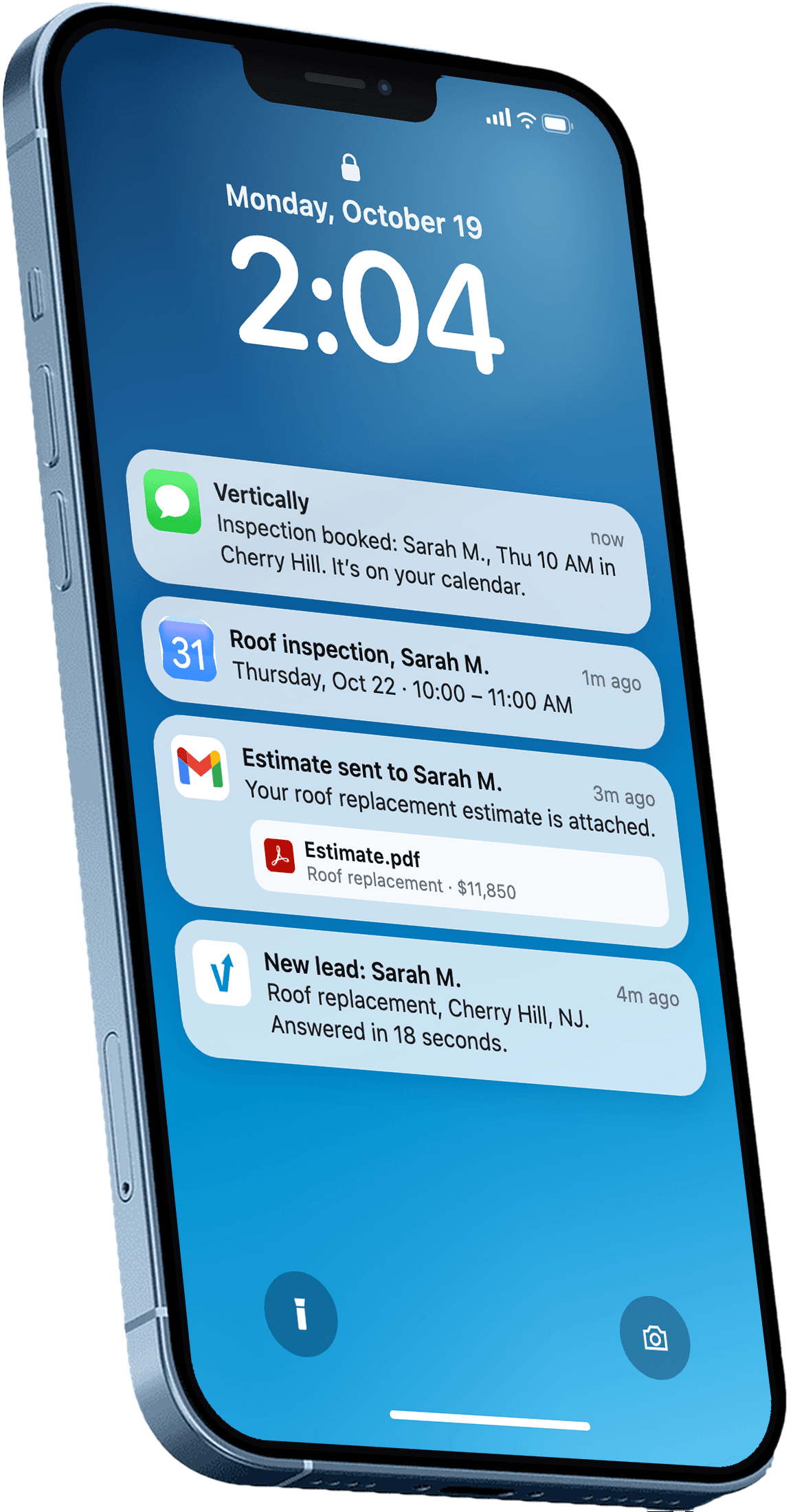
If you'd rather have the first contact and the follow-up sequence run automatically from your website, Vertically is our product for roofing companies. It sends an instant quote, a text, and an AI call about 5 minutes later, then follows up every several days over 28 days until the lead books an inspection or unsubscribes. For more on the first minutes after a request, see what happens in the first five minutes after an online quote request, and for ways to generate more demand to follow up on, read how to get more roofing leads and keep the ones you already have.
If you want to see how this would run on your own website, book a free systems audit with Vertically and we'll walk through your current lead flow. Vertically offers a free 30-day trial with no contract and no credit card.
Frequently asked questions
How many times should I follow up with a roofing lead?
A practical starting point is one immediate response plus roughly 5 to 7 helpful touches over 10 to 14 days. Public roofing-specific data on the exact number is limited, so treat this as a starting cadence and adjust it using your own booking results. Make sure each touch gives the homeowner a real reason to reply.
How fast should I respond to a new roofing lead?
Respond as quickly as you can, ideally within minutes, while the homeowner still remembers asking for help. General lead-response research favors fast first contact, though roofing-specific timing data is thin. Assign one owner per lead so the first response doesn't get delayed by confusion over who is handling it.
Should I text or call a roofing lead first?
Many roofers do both at the same time: a call and a text or email in the first few minutes, so the homeowner has more than one way to respond. If the call goes unanswered, a text that confirms the request and asks for an inspection time works well. Track which channel gets replies for your market and adjust.
When should I stop following up with a roofing lead?
Stop automated follow-up as soon as the homeowner replies, and have a person take over the conversation. Otherwise, end the active sequence after about two weeks and move the lead cold or to a lower-frequency list. Remove leads immediately if they opt out or ask you to stop.
Does a follow-up sequence work without a sales team?
Yes, if one person owns the process and the sequence is written down with clear timing and stop rules. A small roofing company can run a basic cadence from a shared spreadsheet, as long as every lead has an owner and each touch is logged. Automation can help with the repetitive steps, but a named person still needs to handle replies.
Answer every lead in under 30 seconds.
Vertically replies to your leads, sends the quote, calls them, and books the inspection on your Google Calendar. Free for 30 days. No contract, no credit card.
Keep reading
- GuideFirst 5 Minutes After an Online Roofing Quote RequestSee what happens after a homeowner requests a roofing quote online, step by step, and how to respond faster without extra staff.Read more
- GuideHow to Get More Roofing Leads (and Stop Losing the Ones You Have)How to get more roofing leads: practical sources, then why speed to lead and follow-up decide how many you win, with a real roofing case study.Read more