Roofing Lead Generation: 6 Channels Compared
Compare the main roofing lead generation channels, including SEO, paid ads, referrals and lead services, and what each costs you in time and money.
By Toby Karamoutchev
· 5 min read

On this page
Disclosure: Vertically, which publishes this blog, is the author's product and is mentioned briefly near the end of this guide.
Roofing lead generation is the work of getting homeowners to ask you about a job. Most roofers use several sources at once, and each one asks for a different mix of money, time and patience. This guide compares six channels side by side so you can decide where to put your next hour or your next dollar.
Before comparing, it helps to separate two problems. Lead sourcing is how people find you. Lead handling is what you do once they do. Only 28% of roofers use a CRM to track leads, according to Roofr's analysis of Roofing by the Numbers 2025, so many companies lose leads they already paid for. Fixing handling is often cheaper than buying more leads.
What roofing lead generation covers
A roofing lead is a homeowner or property owner who has asked about work, whether by form, phone, text, or a marketplace request. A lead is not a booked job. The gap between the two is where most small companies lose money.
Sources fall into two groups. Owned and earned channels, such as search, reviews and referrals, build over time. Paid channels, such as ads and marketplaces, produce leads while the budget runs and stop when it stops. Most small roofers need some of each, but they should know which is which before they commit.
Comparing the main roofing lead generation channels
Local SEO and Google Business Profile
Local search is where many homeowners start. The Google Map 3-Pack is the block of three local listings that appears for many service searches. Roofing Webmasters describes this channel as depending on an optimized Google Business Profile, a steady flow of reviews and consistent citations. Earning those positions takes setup work and ongoing attention, but the leads cost nothing per click. For setup details, see our local SEO setup for roofers.
Paid ads and local service ads
Google Local Services Ads charge per lead rather than per click. WebFX notes the pay-per-lead model and the Google Guaranteed badge, which can bring high-intent calls quickly. Standard Google Ads and Facebook lead ads work differently: you control keywords or audiences, but you pay for each click or impression whether or not a job follows. Paid channels are good for filling a slow month, and they are most useful once your handling is ready for the volume.
Referrals and partnerships
Referrals convert well because the homeowner already trusts the person who sent them. RoofSnap suggests partnering with complementary trades such as HVAC companies, where an AC replacement can lead to a roof inspection recommendation. Past customers are a referral source too. Ask for introductions at the end of every completed job, and the channel costs little beyond the time it takes to ask.
Paid lead marketplaces
Shared marketplaces sell the same request to several roofers. WebFX recommends treating them as a supporting channel rather than a primary source. The main cost is competition: you may be one of several quotes, and speed matters more than in other channels. Check the price per lead against your close rate before you commit a monthly budget.
Reviews and review requests
Reviews feed both local search rankings and conversion. LocaliQ lists asking for customer reviews as a standard lead tactic, and WebFX recommends requesting reviews within 24 hours of job completion. The channel costs almost nothing, and the timing is the main variable.
Direct mail, door hangers and yard signs
Print still has a place in local lead generation. LocaliQ lists direct mailers, lawn signs and door hangers among its tactics. Results depend heavily on targeting and follow-up, and you should track each piece with a unique phone number or landing page so you can tell which ones produced calls.
How to compare channels for your own company
Score each channel on three things before you spend on it:
- Upfront effort. How many hours does setup take? A paid campaign with landing pages takes longer than a profile update.
- Ongoing cost. Is it free to run, pay per click, pay per lead, or a monthly subscription? Write the number down.
- Time to a usable lead. SEO can take months. A paid campaign can produce calls in days. A referral from a neighbor can come this week.
Then compare the cost per signed job, not the cost per lead. A cheap lead that never books is more expensive than a costly one that closes.
Which channel to start with
Start where you already have momentum. If you have a steady flow of reviews or referrals, put your effort into turning those into more of the same before you buy anything new. If your Google Business Profile is incomplete, fixing it is usually the cheapest first step. Add paid channels after you can handle the volume: a campaign that produces leads does little for you if they wait days for a reply.
Why speed to lead decides which leads you keep
Lead handling often decides whether a channel pays back. Roofr reports that roofers who adopted a CRM plus marketing automation reported generating 2x more leads year over year than those who didn't. The same source describes AI-powered tools such as chatbots and automated follow-up as ways to respond the moment a request arrives, including at night and on weekends.
You do not need a large system to improve this. Set a rule that every web or marketplace lead gets an acknowledgment within minutes, and assign one person to make the first call or send the first quote. Track how many leads go more than 24 hours without contact. That number usually explains more of your lost work than the channel does.
A practical plan for this week
- Audit your Google Business Profile. Check categories, service descriptions, photos, hours and review count. Fix what is missing.
- Pick one channel to improve this month, most likely the one where you already have reviews or referrals.
- Track every lead source in one place: a spreadsheet works. Record the source, the date, whether you contacted them, and whether they booked.
- After 30 days, compare cost per booked inspection by source. Cut or fix the weakest one.
Where Vertically fits
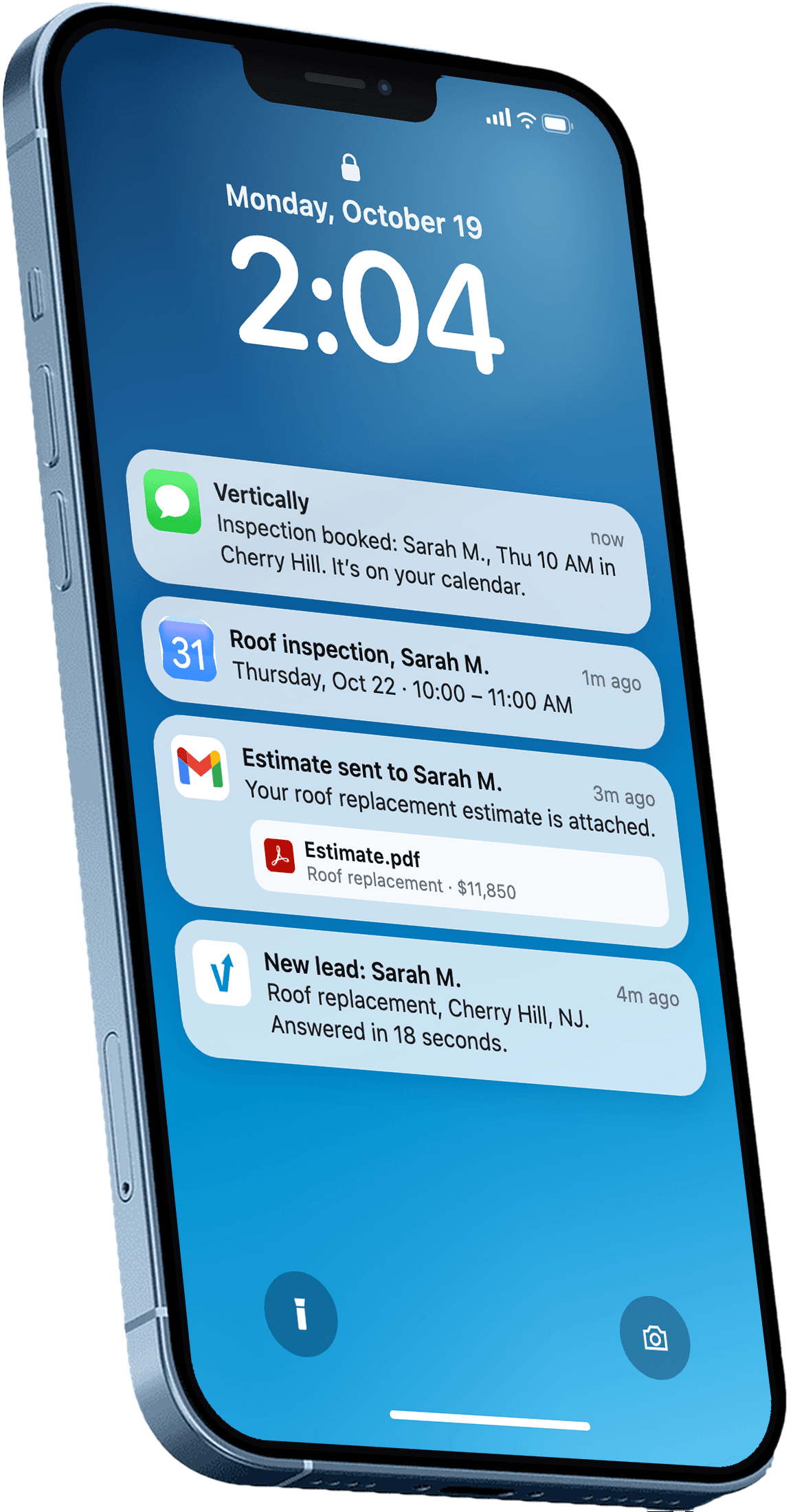
Vertically is the author's product. It runs from your website: a homeowner requests work on a quote page, gets an instant emailed estimate with a branded PDF, and receives a text. About 5 minutes later an AI agent calls on your behalf and can book an inspection, and a 28-day follow-up sequence keeps the lead warm. Details are on the instant lead response for roofing companies page and the quote software page. It does not answer your business phone line.
Related reading: how to get more roofing leads.
Recommendation
Choose one channel this month, track every lead to a booked inspection, and check the cost per booked job after 30 days. If your website is the channel you are building, a free 30-day trial with no contract or credit card lets you see how instant quotes and an automated follow-up call handle new web leads.
Book a free systems audit to review your current lead sources and handling: https://cal.com/vertically/free-systems-audit?overlayCalendar=true
Frequently asked questions
What is the cheapest roofing lead source to start with?
Most small roofers start with the channels that cost only time, such as a complete Google Business Profile, review requests and referrals from past customers and complementary trades. These have no per-lead fee. Track their results for a month so you know which one is worth more of your attention.
How many roofing leads should a small company expect from SEO?
There is no reliable standard number, because results depend on your market, competition and how much work goes into the site and profile. SEO usually takes months to produce consistent results. Measure your own inbound requests from search over several quarters rather than relying on a benchmark.
Are paid lead marketplaces worth it for roofers?
They can be, but only if your close rate on marketplace leads covers the price per lead. Requests are often shared with several roofers, so speed and a clear quote matter more than usual. Test with a small budget and compare cost per booked inspection before increasing spend.
How do I know if a lead source is profitable?
Divide what you spent on the source in a month by the number of jobs it produced, then compare that cost per job with the profit on those jobs. Track each source separately from the first contact through to a signed job. A source with more leads can still be less profitable if its leads rarely close.
How fast should I respond to a roofing lead?
Respond as quickly as you can, ideally within minutes for web and marketplace requests, since homeowners often contact several companies. Set a clear internal rule, such as a first contact the same business day, and track how often you miss it. Faster first contact generally improves the chance of a booked inspection.
Answer every lead in under 30 seconds.
Vertically replies to your leads, sends the quote, calls them, and books the inspection on your Google Calendar. Free for 30 days. No contract, no credit card.
Keep reading
- GuideRoofing SEO: Set Up the Local Pieces FirstRoofing SEO starts with your Google Business Profile, service pages and reviews. Here is the order to work through them this month, with sources.Read more
- GuideHow to Get More Roofing Leads (and Stop Losing the Ones You Have)How to get more roofing leads: practical sources, then why speed to lead and follow-up decide how many you win, with a real roofing case study.Read more