Per Minute vs Per Call Answering Service Pricing for Roofers
Compare per-minute, per-call and flat-rate answering service pricing for roofers, with storm-season overage math and what to check before you sign.
By Toby Karamoutchev
· 5 min read

Answering service pricing per minute vs per call is a choice that looks simple on a pricing page and gets expensive during a storm. A plan that fits a normal week can double or triple when hail hits and call volume jumps. Before you pick a model, run the numbers against your own call history, including the one weekend a year that matters most.
Vertically, which publishes this blog, makes one of the products discussed below, so weigh that when you read the comparison.
Why answering service pricing per minute vs per call matters for roofers
Roofing demand comes in bursts. A single hail event can produce a flood of inbound calls in a couple of days, then drop back to a normal week. Pricing that looks reasonable on a quiet Tuesday can behave very differently on the weekend after a storm.
Why normal-week call volume misleads you
If you size a plan using an average week, you will underbuy. Pull your last 12 months of call logs, mark the storm weeks, and price those separately from the rest.
What storm weekends do to a bill
How per-minute answering service pricing works
Per-minute plans sell a block of minutes at a base price. Once you go past the block, each extra minute costs more than the base rate, so your effective price per minute climbs in exactly the weeks you can least afford it.
Base plans and overage
Hicira's 2026 price guide gives a clear example: a plan with 100 minutes at $150 a month, used for 140 minutes, becomes $150 plus 40 extra minutes at $1.75 each, or $220. Overage rates in that guide run from $1.50 to $3.50 per minute.
Where the bill jumps
Watch for these before you sign:
- Whether unused minutes roll over or expire.
- Whether after-hours or weekend calls cost extra.
- Whether a long call (for example, a homeowner describing a leak) bills at the same rate as a short one.
How per-call answering service pricing works
Per-call plans charge for each handled call, usually with a monthly base on top. The unit is the call, not the minute, so a long call and a short call cost the same. That makes per-call pricing easier to predict for jobs where callers talk for several minutes.
What counts as a call
Definitions vary. Some vendors count spam calls, wrong numbers and voicemails as billable calls. Hicira notes that spam calls and wrong numbers count as calls too, and that some services filter them while many do not. Ask for the definition in writing.
Hybrid AI and human escalation
Many per-call services are hybrids: an AI agent takes the call and a human joins when needed. OnCrew's September 2026 roofing comparison lists Smith.ai's AI tier as free for 25 calls a month, then $3.00 per call on that free tier and $2.50 per call on its $150 plan with 75 calls. com/blog/best-answering-services-roofing-companies).
Run the math on your own call volume
Use one table to compare the three models against your numbers. Fill in your typical weekly calls, a storm-week multiple (use your own history, not a published figure), and each vendor's billing rule.
| Model | Billing rule | Normal week (your calls) | Storm week (your calls) |
|---|---|---|---|
| Per-minute | Base + minutes over block × overage rate | Base + any overage | Base + overage at peak |
| Per-call | Monthly base + calls × per-call rate | Base + calls × rate | Base + storm calls × rate |
| Flat-rate | Fixed monthly fee | Fixed fee | Same fixed fee |
Then calculate the storm-week total for each model. Multiply your average call length by your storm call count to get minutes, and compare that to each plan's block.
Factor in the cost of a missed job
A cheap plan that drops calls costs you jobs. Before you decide, estimate what a missed call is worth to you. Our breakdown of how much revenue roofers lose missing calls walks through that calculation. Compare the cost of the plan against the value of the calls it actually answers.
What to check before you sign a roofing answering service contract
Price is only one line of the contract. These questions will show you where the real costs sit.
Billing questions to ask
- How are overage minutes or calls billed, and at what rate?
- Do storm-driven surges trigger a higher tier or a surcharge?
- Do minutes roll over, or do they expire at month end?
- Are extra phone numbers or after-hours coverage billed separately?
Get the answers in writing, and ask for a worked example using your busiest month.
Trial terms and cancellation
Read the cancellation clause before the trial starts. OnCallClerk's directory lists 14-day trials for several per-minute and per-call services. Check whether a trial converts to a paid plan automatically, and whether you can cancel without a notice period.
Our checklist of what to look for in a roofing answering service before you sign covers more of these terms.
Where a flat-rate roofing answering service fits
A flat-rate plan removes the overage problem: the storm-week bill matches the normal-week bill. The tradeoff is that you need to confirm what the flat fee actually covers.
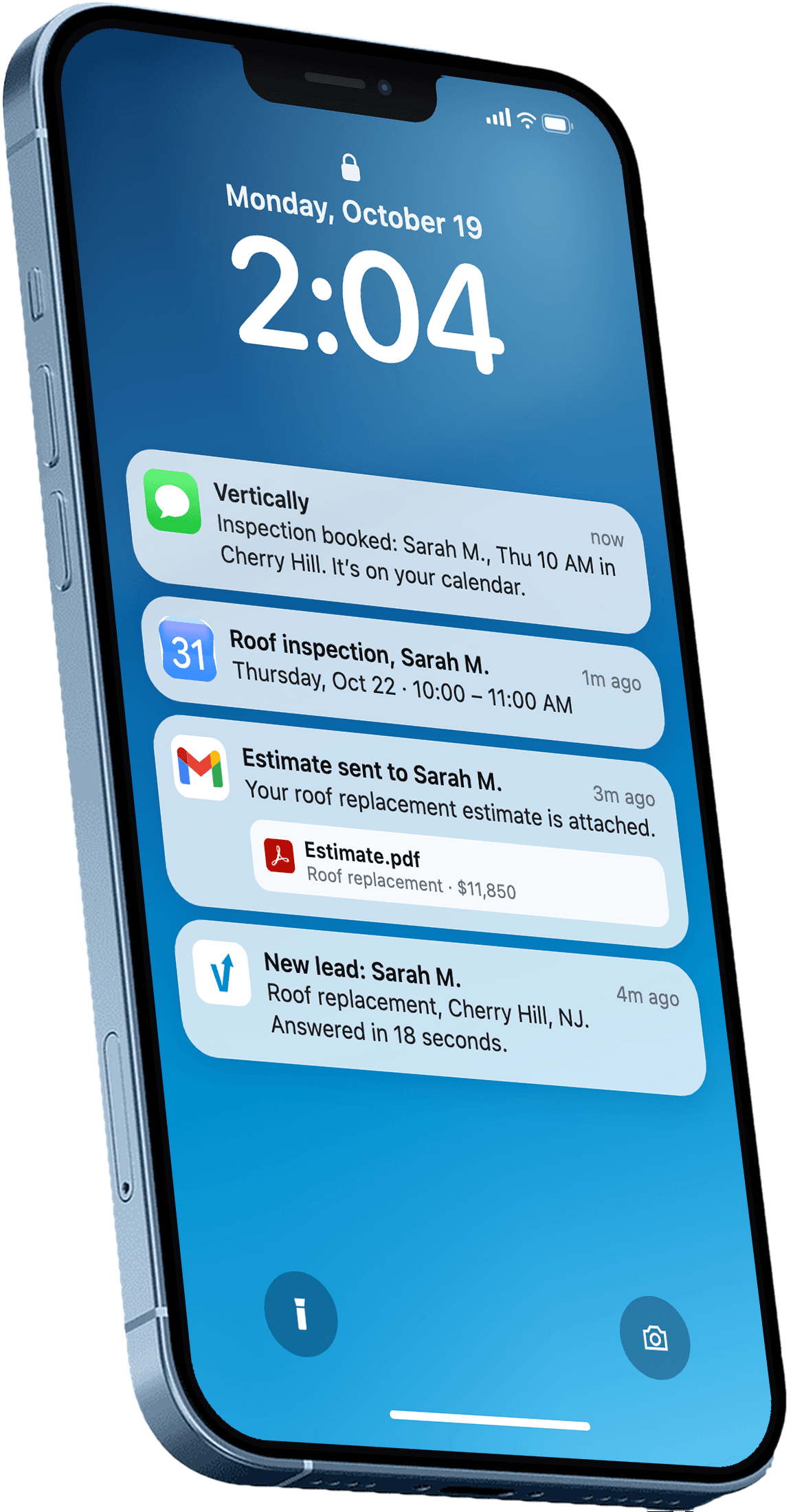
Vertically does not answer inbound calls or your business line. It is a roofing answering service that responds to web quote requests instantly: the homeowner gets an instant quote, a text, an AI call about 5 minutes later, a booking and a follow-up sequence. If most of your leads come through your website and you want a flat monthly cost, that model fits. If you need a live person on your phone line, a phone answering service is a different product.
Recommendation: what to do this week
Pull your call log for the last 12 months and mark the storm weeks. For each candidate, price your three busiest weeks using the billing rules in writing, not the headline rate. Then decide which model holds up when the storm hits, not which one looks cheapest in a normal week.
Want to see how an instant quote and an AI call would work on your own site? You can start the free 30-day trial, with no contract and no credit card, and walk through the setup on your quote page.
Frequently asked questions
Is per-minute or per-call answering service cheaper for a small roofer?
It depends on call length and volume. Per-minute plans tend to suit short calls with steady volume, while per-call plans are usually easier to predict when callers describe a problem for several minutes. Price both models against your own call log, including your busiest week, before deciding.
How much does a roofing answering service cost in a normal month?
Published entry prices vary widely, from flat-rate AI plans starting around $29 a month to live per-minute plans in the $235 to $325 range. Totals depend on the plan's included volume and on any overage. Ask each vendor for a written estimate based on your typical monthly call count.
What happens to answering service bills during a hailstorm?
On per-minute and per-call plans, the bill rises with the number of calls and minutes, often sharply once you pass the included block. Flat-rate plans keep the same monthly fee regardless of volume. Check whether surge calls trigger an extra charge before you sign.
Do answering services charge for voicemail or missed calls?
Some do, and it depends on the vendor's definition of a billable call. Spam calls, wrong numbers and voicemails may count toward your total on some plans. Ask for the definition in writing and confirm whether those interactions are filtered out.
Is a flat-rate answering service better than per-minute billing for roofing?
A flat rate gives you predictable costs during storm surges, which is the main advantage for roofers. The right choice depends on whether the service covers the work you need, such as answering a live line or responding to web leads. Compare what each plan includes, not just the monthly price.
Answer every lead in under 30 seconds.
Vertically replies to your leads, sends the quote, calls them, and books the inspection on your Google Calendar. Free for 30 days. No contract, no credit card.
Keep reading
- GuideHow Much Revenue Do Roofers Lose Missing Calls?How much revenue do roofers lose missing calls? Compare the math, the sources behind the numbers, and what a fix costs versus the leak.Read more
- GuideWhat to Look for in a Roofing Answering Service Before You SignA practical checklist for choosing an answering service for roofing companies: coverage, speed, booking, quoting, handoff, pricing, contracts, data access.Read more