Human vs AI Call Answering for Contractors: 6 Mistakes
Avoid the costly mistakes roofers make when choosing human vs AI call answering for contractors, from storm-surge gaps to unclear pricing and handoffs.
By Bogdan Stere
· 4 min read
Choosing between a human answering service and an AI agent sounds like a preference call, but for roofers it is an operations decision. Demand spikes with the weather, so the setup that works on a quiet Tuesday can fail on the Saturday after a hailstorm. Human vs AI call answering for contractors comes down to whether the method holds up under surge, after hours and at the moment a caller becomes a lead.
Below are six mistakes that cause these setups to fail, and what to do instead.
Why the Choice Between Human and AI Call Answering Matters for Roofers
Roofing demand is not steady. OnCallClerk's comparison of AI and human answering for roofers describes how severe weather drives much of the replacement work into short windows, which means the model that answers the most calls fastest during a surge tends to capture the most jobs.
Missed calls are a common problem across the trade. Leaping AI's guide on AI answering for roofing contractors cites research that approximately 27% of incoming calls go unanswered. Coverage gaps are not hypothetical.
Mistake 1: Choosing Based on Average Call Volume
Most providers quote for a normal week. A single hailstorm can drop 300 calls on a mid-size residential roofer in a 24-hour window, according to Layer3Labs' guide on storm-driven call spikes. That guide notes that a human front office with three simultaneous callers leaves two on hold, while an AI answers calls in parallel.
Ask every provider what happens to your bill and your pickup time during a storm weekend, not just in a typical month.
Mistake 2: Comparing Hourly or Per-Minute Rates Without the Real Monthly Minutes
Billing models change the math. OnCallClerk's pricing review of best answering services for roofers lists several providers by billing model, and shows that per-minute and per-call billing both scale with call volume. The same provider can look cheap in a quiet month and expensive in a surge month.
Before you compare numbers, estimate your real monthly minutes or calls, including your worst storm month. For a deeper breakdown, see per minute vs per call answering service pricing for roofers.
Mistake 3: Expecting a Human Service to Qualify and Book as Consistently as Software
Human receptionists bring warmth and can handle an unexpected question well. But consistency is harder. RooferFuel, which sells AI answering, argues in its comparison of AI answering and call centers that a shared agent juggling scripts for many businesses varies in how they qualify leads, and that call centers scale cost and pickup time with volume.
If you use a human service, write the qualification script yourself and audit a sample of calls each week.
Mistake 4: Expecting an AI Agent to Handle Every Complex Conversation Alone
AI is strong at repeatable intake: storm damage, active leak, insurance claim status, inspection booking. It is weaker on a multi-building commercial re-roof bid or a frustrated homeowner who needs a human to step in. OnCallClerk's comparison makes this point directly and notes that roofers can pair AI for intake with human escalation.
Decide in advance which calls escalate to a person, and to whom.
Mistake 5: Skipping the Handoff and the Follow-Up
An answered call is not a booked job. The lead can still go cold if nobody calls back, or if the details captured on the call never reach the person who schedules the inspection. Leaping AI's guide describes routing hot leads to a sales team and sending confirmations, but that routing only works if someone defined it.
Write down three things: who receives each lead type, how fast they must act, and where the lead is logged. A simple rule such as "storm leaks go to the crew lead by text within 15 minutes" is more useful than a general promise of fast response.
Mistake 6: Not Confirming Who Gets the Lead and How Fast They Hear About It
This is the mirror of mistake 5. Even when the call is answered and captured, owners often do not confirm the notification path. A text to a foreman who is on a roof, an email nobody checks on weekends, or a handoff that depends on one person all create gaps.
Test the path before you rely on it: place a test call at 7 p.m. on a Saturday and time how long it takes for the right person to get the details.
How to Pick the Right Setup This Month
Use a short checklist before you commit:
- Run a weekday test, a weekend test and a simulated storm-day test of call volume.
- Ask each provider for the bill at 10, 50 and 150 calls in a single day.
- Write the questions each lead must answer before a quote or inspection is booked.
- Define the escalation path for complex or commercial calls.
- Confirm who gets notified, by what channel, and how fast.
If you are comparing software options, roofing virtual assistant vs AI receptionist and what to look for in a roofing answering service before you sign cover the buying questions in more depth.
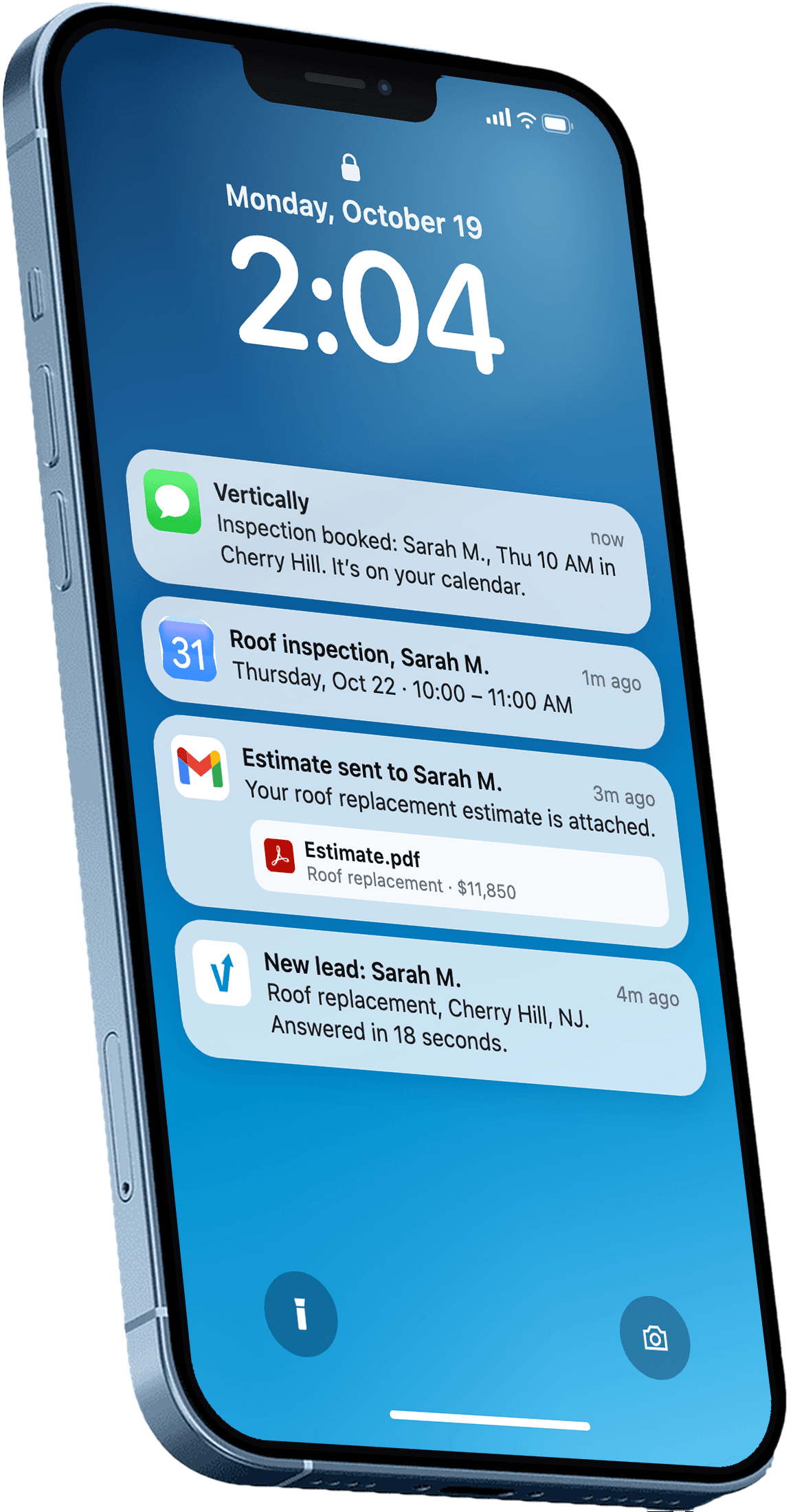
If you also want to see what a web lead looks like after the call, Vertically is the author's product. Vertically does not answer inbound phone calls. It responds to web leads instantly with a quote and a text, then places an AI call about 5 minutes later and can book the inspection on your calendar.
Next Step
Pick one week in the next month and run the storm-day test above on whatever setup you use now. Write down where calls or leads stalled, then fix the handoff before you change vendors.
Want to see how web leads move through the same steps? Book a free systems audit and we will walk through your current flow. Vertically does not answer your business line, but it can handle your web leads instantly and start a booking conversation while your crew is on the roof.
Frequently asked questions
Is AI call answering accurate enough for roofing calls?
AI works well for repeatable intake such as storm damage, active leaks, insurance claim status and inspection booking. Complex commercial bids and upset callers usually need a human to take over. Test any system on your real call types before you rely on it.
Do roofers need a human receptionist if they use AI answering?
Not always, but many roofers choose a hybrid setup where AI handles intake and surge volume and a human takes escalations. Decide who handles complex calls before you sign up. If your volume is steady and low, a human service alone may be enough.
How much do roofing answering services usually cost?
Pricing varies by billing model: flat monthly, per call or per minute. OnCallClerk's review of best answering services for roofers lists starting prices and billing models for several providers. Estimate your monthly minutes or calls, including a storm month, before comparing.
What happens to calls that come in after hours?
It depends on the service. Some human services offer after-hours tiers and AI agents can answer around the clock. Confirm how after-hours emergencies are flagged, who gets notified and how fast, and test it on a weekend.
Answer every lead in under 30 seconds.
Vertically replies to your leads, sends the quote, calls them, and books the inspection on your Google Calendar. Free for 30 days. No contract, no credit card.
Keep reading
- GuidePer Minute vs Per Call Answering Service Pricing for RoofersCompare per-minute, per-call and flat-rate answering service pricing for roofers, with storm-season overage math and what to check before you sign.Read more
- GuideRoofing Virtual Assistant vs AI Receptionist: Which One Fits a Small Roofing Company?Roofing virtual assistant or AI receptionist? An honest comparison of cost structure, hours, speed, and what each can do, and when each is the better choice.Read more
- GuideWhat to Look for in a Roofing Answering Service Before You SignA practical checklist for choosing an answering service for roofing companies: coverage, speed, booking, quoting, handoff, pricing, contracts, data access.Read more