Does an AI Receptionist Work for Roofers? 6 Mistakes
Does an AI receptionist work for roofers? Learn six common setup and expectation mistakes to avoid so your roofing company gets real value from it.
By Toby Karamoutchev
· 5 min read
Disclosure: Vertically is the author's product. It is mentioned once, near the end of this post, and only for web leads.
Does an AI receptionist work for roofers? It can, but only for certain jobs. An AI receptionist works when the goal is to answer every call, sort real buyers from tire-kickers, and book the next step. It struggles when a call needs human judgment, a licensed opinion, or a careful conversation about a large replacement. Most failures come from how the tool is set up and what owners expect from it, not from the technology itself.
This guide covers where an AI receptionist fits a roofing company, and six mistakes that cause it to fail.
Does an AI receptionist work for roofers at all?
The short answer is yes for intake, no for judgment. An AI receptionist is essentially a front desk that never sleeps and never sends a call to voicemail. A GrowthLeaks evaluation of AI receptionists draws the same line: the tool works for answering, qualifying and booking, and a person still handles the roof inspection, the insurance nuance and the close on a large job.
Where it fits: after-hours, storm-surge and overflow call intake
The strongest fit is calls you currently lose. That includes the 8 p.m. leak call, the call that comes in while your crew is on a roof, and the surge after a storm. Astraresults makes the point that storm windows produce intake surges no realistic staffing level absorbs, and that AI tools can handle many concurrent calls when humans cannot.
Concurrency is the spec to check. Futuro's 2026 comparison notes that a three-person office can answer three calls at once and send the rest to voicemail, and that human services hit their own ceiling when every roofer is busy the same night. Ask any vendor how many simultaneous calls your plan supports.
Where it does not fit: judgment-heavy calls and emergencies
An AI receptionist should not diagnose, give coverage advice or talk a nervous homeowner through a large replacement. Active leaks and collapse risks should route to a human on-call number. AINORA's 2026 guide lists genuine emergencies, legal or insurance disputes and complex coordination as categories that transfer to a person.
Set the expectation that it is a hand-off tool, not a replacement for a human front desk. The goal is to book the right person into the right conversation, quickly.
Six mistakes that make an AI receptionist fail for roofers
Mistake 1: No defined qualifying questions
If the tool does not know what to ask, the notes it returns are useless. For a roofer, the minimum intake is property address, damage type or symptom, whether the caller is working through an insurance claim or paying out of pocket, roof age if known, and a callback window. Aira's guide to AI receptionists for roofing describes capturing name, address, damage description and insurance carrier as the core of a storm-surge call. Write your intake list before you configure anything.
Mistake 2: No emergency routing
An active leak is not the same as an estimate request. If the AI treats every call the same way, a homeowner with water coming through the ceiling may wait for a callback that never comes. Define in writing which calls go straight to a person: active leaks, visible structural damage, and anything involving a tarp or ongoing water entry. AINORA recommends transferring genuine emergencies to an on-call number with full call context, so the human starts with the details.
Mistake 3: Ignoring booking integration
Booking that does not reach your calendar is just a loose note. Before you commit, confirm the AI can read your real availability and write the appointment where your crew will see it. If the tool cannot connect to your calendar or CRM, every call adds manual work instead of removing it.
Mistake 4: Skipping concurrency
Many owners test an AI receptionist with one call at a time, then discover it fails during the storm week that justified buying it. Test with overlapping calls, or ask the vendor for the concurrency limit in writing on your plan. Futuro recommends asking directly how many simultaneous calls your plan allows.
Mistake 5: Expecting it to close judgment work
The AI can book the inspection. It should not be expected to win a large replacement or explain what an insurance adjuster will decide. GrowthLeaks puts the division plainly: the AI books the visit, and a person closes it. Pricing disputes and complicated claim questions still belong to you or your estimator.
Mistake 6: Treating the call as the end of the lead
A booked call is not a finished sale. Many homeowners need several touches before they commit to an inspection or a quote, and a call that books nothing still deserves a follow-up. Plan the sequence after the call: a confirmation text, a reminder before the inspection, and a check-in if the homeowner does not book. For a practical schedule, see roofing lead follow-up cadence.
How to decide if it works for your roofing company
Run a simple test before you commit. Call your own business line after hours and during a busy time. Then check four things:
- Did the caller get booked, or left with a vague promise?
- Did an emergency reach a person quickly?
- Does every call leave a note you can act on without listening to the recording?
- Did the booking land on the calendar your crew actually uses?
Also compare results before and after. Track your missed-call rate and how often voicemails got a callback. Measure your own callback rate rather than relying on outside statistics about how often voicemail callers return.
For a deeper comparison of voicemail and AI receptionists, see AI receptionist vs voicemail for contractors, and for what to say on the call, see phone scripts for roofing call intake.
How Vertically fits, if you want web leads covered too
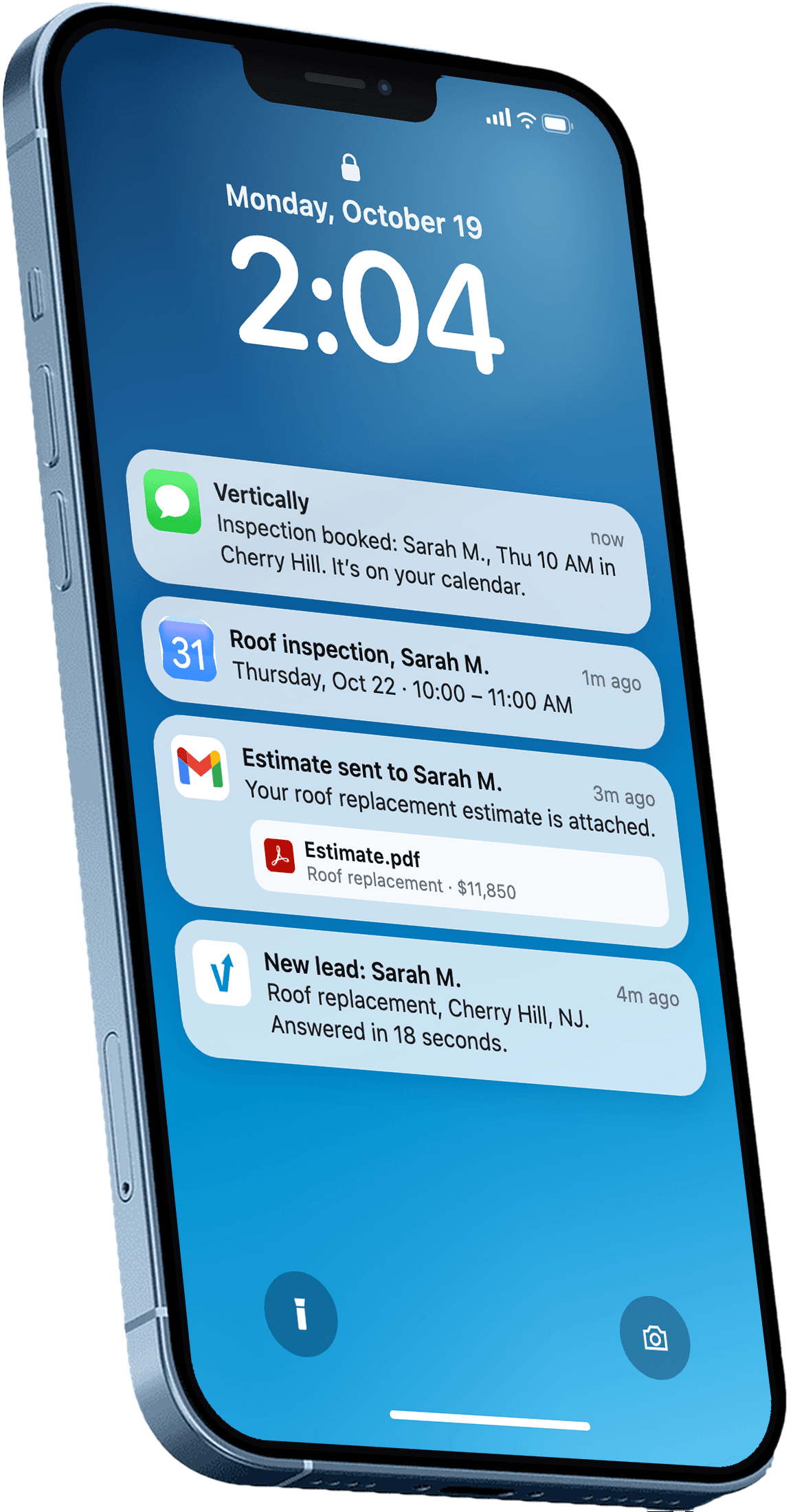
Vertically does not answer your inbound business line or act as a receptionist for your phone calls. It handles web quote requests from your website: the homeowner gets an instant quote by email, a text, and an AI call about 5 minutes later from your company, which can book the inspection directly into your Google Calendar. If your website brings in leads that go cold, that part of the funnel is what Vertically covers, alongside whatever you use for phone calls. You can compare options on the roofing answering service page.
Recommendation for this week
Write your intake list, define your emergency rules, and test any AI receptionist by calling it at the busiest time you can. If it cannot book into your real calendar and handle overlapping calls, it is not ready for storm season. Start a free 30-day trial with no contract or credit card to see how instant quotes and the AI call about 5 minutes later handle your web leads. Book a free systems audit to see whether it fits your web lead flow.
Frequently asked questions
Does an AI receptionist replace a human receptionist for a roofing company?
Not entirely. An AI receptionist works best as a hand-off tool that answers calls, gathers details and books the next step. A person still handles inspections, insurance questions, pricing disputes and the close on large jobs.
What calls should a roofer never hand to an AI receptionist?
Active leaks, roof collapse risks, anything involving ongoing water entry, legal or insurance disputes, and complex pricing questions should go to a human. Define these emergency and judgment categories in writing and route them to an on-call number with the call context attached.
How do I know if an AI receptionist is booking real inspections?
Call your own line after hours and check whether the caller ends up on your actual calendar, not just in a note. Confirm the tool connects to the scheduling system your crew uses, and track how many booked calls turn into completed inspections.
Does an AI receptionist handle storm-season call volume?
It can, if the plan supports enough simultaneous calls. Ask the vendor how many concurrent calls your plan allows and test overlapping calls before storm season, since a small human-staffed office can only answer a few calls at once.
Answer every lead in under 30 seconds.
Vertically replies to your leads, sends the quote, calls them, and books the inspection on your Google Calendar. Free for 30 days. No contract, no credit card.
Keep reading
- GuideRoofing Lead Follow-Up Cadence: A Practical ScheduleBuild a roofing lead follow-up cadence with timing, channels, message goals, stop rules, and tracking to see which touches book inspections.Read more
- GuideAI Receptionist vs Voicemail for Contractors: A GuideCompare an AI receptionist vs voicemail for contractors. See what each does with after-hours and missed calls, and how to decide for your roofing company.Read more
- GuidePhone Scripts for Roofing Call Intake: A ChecklistUse this checklist to build phone scripts for roofing call intake: greeting, required questions, urgency rules, and a follow-up text your team can use today.Read more